
Ailangantunturi pumped storage power plant
Ailangantunturi pumped storage power plant
-
Technical information
Technical information
Plant type: Pump turbine
Head potential: Approx. 200 metres
Capacity: 550 megawatts (MW)
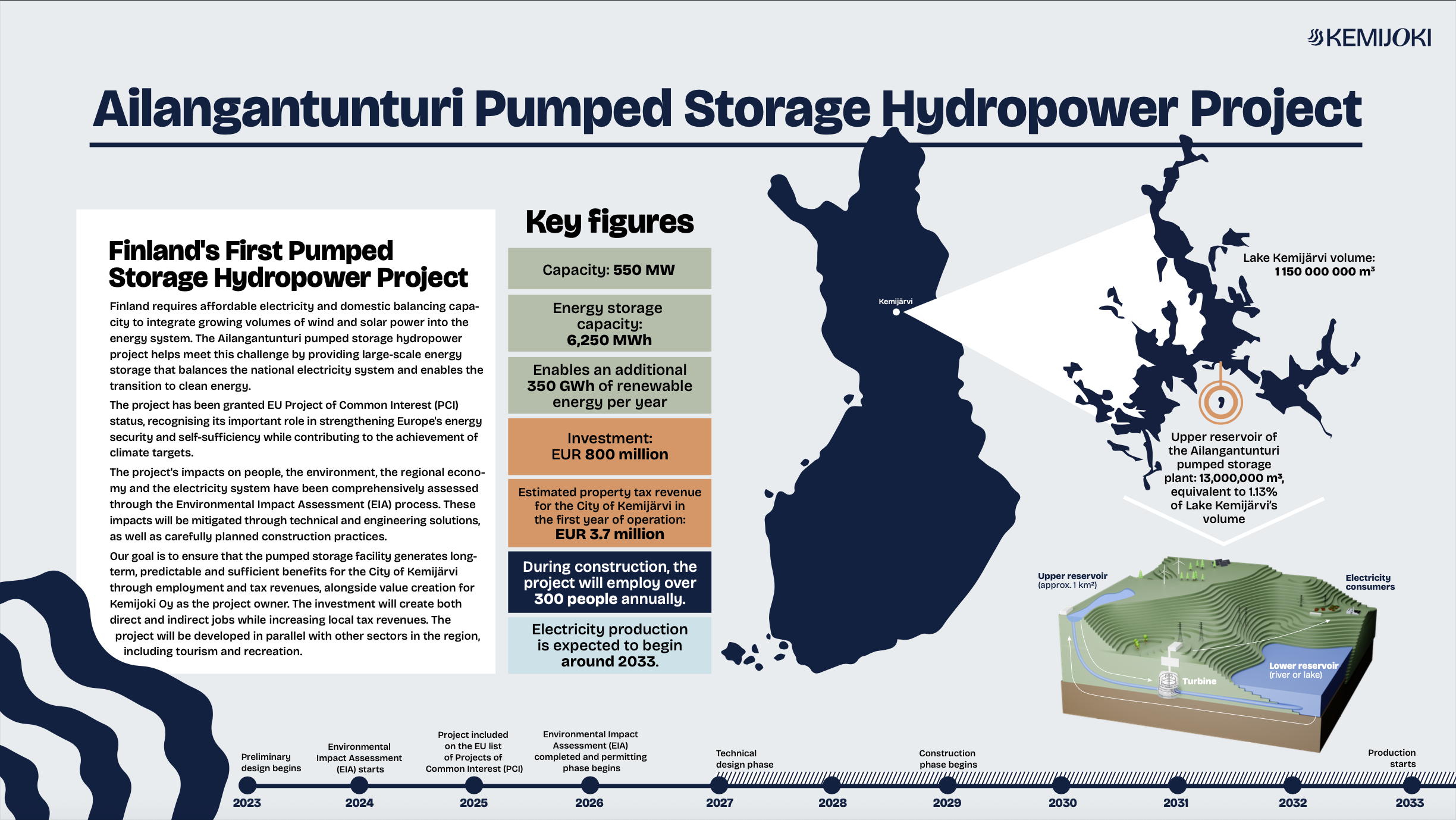
Number of machinery: 3The project area is located approximately 22 kilometres south of the centre of Kemijärvi. The transmission line will be located in the municipalities of Kemijärvi and Rovaniemi. The upper reservoir of the pumped storage plant, covering an area of approximately one square kilometre, is planned to be constructed on top of Ailangantunturi. The lower reservoir will be the Kuusilahti bay of Lake Kemijärvi. The tunnel connecting the upper and lower reservoirs will be approximately 4.5 kilometres long and have a diameter of 9 metres.
The electricity generated by the plant will be connected to Fingrid’s Pirttikoski substation in Autti. The transmission line voltage will be 400 kilovolts.
Project schedule
According to the preliminary schedule, construction could begin at the earliest in 2029, with commercial operation commencing in 2032.
Towards a secure energy transition
The pumped-storage power plant we are planning at Ailangantunturi in Kemijärvi supports Finland’s clean energy transition and helps ensure the smooth functioning of everyday life in society. The plant will increase national energy storage capacity, strengthen security of supply, and support the growth of renewable energy.
We are working in close cooperation with the authorities on the project and are developing local stakeholder collaboration through continuous dialogue with the local community. Through this approach, we want to ensure that everyone affected by Finland’s first pumped-storage power plant is heard and receives comprehensive information.
Assessing the project’s impacts on the environment and people
The project is currently undergoing an Environmental Impact Assessment (EIA) procedure for both the pumped-storage power plant and the associated transmission line. The aim of the assessment is to reduce or completely prevent adverse environmental impacts and to improve access to information as well as opportunities for participation and influence for all stakeholders.
The environmental impact assessment has examined the project’s effects on surface waters, fishing and fish stocks and aquatic ecosystems, soil and bedrock, groundwater, vegetation, birdlife and habitat types, Natura 2000 sites and other protected areas, reindeer husbandry, local traffic, noise and vibration, climate and air quality, community structure and land use, landscape and cultural heritage, as well as people and society.
The project’s Environmental Impact Assessment (EIA) Report was submitted to the coordinating authority in summer 2025, with a supplementary version submitted in April 2026. On 8 July 2026, the coordinating authority issued its reasoned conclusion, confirming that the report meets the statutory content requirements and is of sufficient quality. Efforts to assess, address and mitigate the project’s environmental impacts will continue throughout the ongoing permitting process.
According to the preliminary schedule, construction of the Ailangantunturi pumped-storage power plant could begin at the earliest in 2029, with electricity production starting in 2032.
Subscribe to our Lieke newsletter (in Finnish) to hear the latest updates on the project.
More information:
- PCIs on the European Commission’s website and transparency platform. Ailangantunturi pumped storage power plant’s PCI number and description: 3.10 Hydro pumped electricity storage in Finland [’Kemijoki PSP’].
- Press release regarding the project as a part of the public hearing (in Finnish).
Page updated on 17 September 2026.